Pages

Showing posts with label Steelhead. Show all posts

Friday, July 29, 2016

Take Action for Wild Steelhead


The Caddis Fly passes on a call to action from the Native Fish Society to tell WDFW to designate the entire Skagit as a wild steelhead gene bank. Go HERE and let your voice be heard.


Tuesday, July 12, 2016

Cast Northwest: First Ever Steelhead on Paddle Board With Spey Rod

If you can get past Captain Quinn vogueing on a paddle board, there's some beautiful footage of northwest BC and its steelhead.

Thursday, April 7, 2016

The Wild Steelheader, April 7, 2016

When truly great things happen for wild steelhead recovery, it is important to share the news.   We took one of the greatest steps forward in wild steelhead recovery yesterday at the mouth of the Klamath River.  Secretary of the Interior Sally Jewell, California Governor Jerry Brown and Oregon Governor Kate Brown signed new amendments to the Klamath Hydropower Settlement Agreement (KHSA) and a related Klamath Power and Facilities Agreement.  The revised KHSA will ensure that removal of 4 major dams on the Klamath River takes place as scheduled in the year 2020, opening about 500 miles of wild steelhead habitat.  Take a moment to thank Secretary Sally Jewell, California Governor Jerry Brown, and Oregon Governor Kate Brown.  


To learn more, read the story by Sam Davidson below.

Major win for one of America's best coldwater fisheries


By Sam Davidson

Five hundred miles. That’s a pretty significant distance, right? Now, imagine swimming that far.
That’s how many river miles will re-opened to native steelhead in the Klamath River under the terms of a revised agreement between the federal government, the states of California and Oregon, and the utility company PacifiCorp.

The amended Klamath Hydropower Settlement Agreement, and the Klamath Power and Facilities Agreement were signed today at the mouth of the Klamath River by Secretary of the Interior Sally Jewell, NOAA Administrator Kathryn Sullivan, Gov. Edmund G. Brown, Jr., of California, Gov. Kate Brown of Oregon and PacifiCorp CEO Stefan Bird.

Under the new-and-improved KHSA, four old, unproductive hydropower dams on the Klamath River will be removed beginning in the year 2020. This action will open up 500 miles of habitat for steelhead and some 420 miles for salmon.

PacifiCorp and the state of California will pay for the cost of dam removal using existing funds already set aside for this purpose. No federal funds will be required.

“This is a major win for one of America’s greatest coldwater fisheries,” said Chris Wood, president and CEO of Trout Unlimited. “The river restoration called for under the new KHSA will be the largest in U.S. history. TU is proud to have played an important role in the long effort to bring about this restoration and to resolve one of our country’s most intractable water challenges.”

TU California Director Brian Johnson has been closely involved in the many years of difficult negotiations that led to the amended agreement. Johnson attended the signing ceremony today and spoke to the benefits of the agreement for fish—and people.

“The Klamath, historically, has been the third most productive river system for salmon and steelhead on the West Coast,” he said. “Thanks to the leadership of Secretary Jewell, Gov. Brown of California and Gov. Brown of Oregon, and PacifiCorp, we now have a real chance to return it to its former glory.”

At the same time, Johnson added, “TU remains dedicated not only to restoring one of America’s greatest salmon and steelhead fisheries, but also to adoption of durable water-sharing agreements that will provide greater water security for tribes, upper basin agriculture and communities up and down the river.”

TU issued a joint statement today on the signing of the amended KHSA, with the Pacific Coast Federation of Fishermen’s Associations, California Trout, the Northern California Council of the International Federation of Fly Fishers and American Rivers. The statement declares strong support for dam removal on the Klamath and calls for renewed commitment to a “basin-wide solution for water sharing, water supply infrastructure, and habitat restoration.”

Johnson is quoted in advance reports on the KHSA signing ceremony from theAssociated Press and the San Francisco Chronicle. An overview of Klamath River water issues and the settlement agreement process can be found here and here.

Sam Davidson is California Communications Director for Trout Unlimited. Lower photo: Brian Johnson just below Iron Gate Dam, Klamath River.


Click the link below to log in and send your message:
https://www.votervoice.net/BroadcastLinks/AD1LEfns2QipqwFXZ8Kt0g 

Saturday, February 20, 2016

Big Sky Journal: "Outside: Fish on the Brain" by Greg Thomas

I thought my brother John would like this one. He's fished the Clearwater and wants to go back.


Outside: Fish On The Brain

Twenty-four hours for steelhead

Written by Greg Thomas  
Illustrated by Fred Thomas  
February 2016


Giving yourself just 24 hours to catch a steelhead and then setting out on the road to do so is one of angling’s worst gambles. Especially when you must drive three and a half hours along one of the windiest roads in the West, over a notorious mountain pass, just to reach these fish. Steelhead don’t exist in Montana. You have to get to Idaho or beyond to find them.
A friend and I took that bet in November. He somehow convinced me that leaving Missoula at 8 p.m., just after I coached my girls’ basketball team to an overtime loss, was a great idea. I had no voice and seemingly little sense, the latter due to my friend’s propensity to drive at the very limits of physics. On this trip I have to remind him that all that waits ahead are a couple whiskeys and a night of sleep; we won’t miss a thing if he drives a safe 60 miles an hour versus 80.
I say this each time he drives, mostly as a valid mark of concern, but also to see his reaction. “You worry about the songs on the iPod, and I’ll drive,” he says, adding, “You’re just nervous because you’re not used to the sway.”
The “sway” is a sensation brought on by the tipping of his 3,000-pound Lance camper. At each bend, as he hits the brakes and my eyes get wide, the whole truck seems to lift onto two wheels before, miraculously, finding purchase again. On this particular road, Highway 12 between Lolo, Montana, and Orofino, Idaho, we go through this process perhaps 600 times. While negotiating one particularly sharp turn he glances up at me and says, “My girlfriend has to medicate when she rides with me.” I ask the obvious question: “Does she have any of that stuff stashed in here?” By the time we park at an access site along the Clearwater River, I am worn out but glad to be here in one piece, with nothing more to do than swing flies for steelhead.

Read more.

Wednesday, January 20, 2016

The Wild Steelheader, January 19, 2016

January 19, 2016

Hello,


As I write this, we are deep in the heart of winter steelhead season. Snow levels have crept down in elevation and river gauges resemble roller coasters.  One thing is now certain: We finally have water.
After a summer of lethal river temperatures and wildfires, is it ok to complain about blown-out or frozen rivers? Probably not.

If we learned one lesson from last summer it was the need to redouble our efforts to restore and protect wild steelhead.

And we are continuing down that path. This winter we will see volunteers planting trees, monitoring stream temps, throwing fundraisers, counting redds, conducting snorkel surveys and taking action for crucial policy changes, all in the name of wild steelhead conservation.

We do this because we are steelheaders -- because opportunity means getting out there on a beautiful river and, if the fishing gods are generous, hooking into a silver bullet.

I wish you good fortune in your winter steelheading, and encourage you to dedicate that same level of passion and action to wild steelhead conservation.

Dwayne Meadows
Pacific Northwest Outreach Coordinator
Trout Unlimited

Three things you can do right now to help wild steelhead

  1. We have a chance to protect 70 key watersheds for steelhead and salmon in the Tongass National Forest, home to some the most intact habitat in the U.S.  Please let your comments be heard by Feb 22nd.

  1. Commit yourself to get involved or donate. Go to a local Trout Unlimited meeting and ask how you can help with your local river. You can find it here. Forward this newsletter to friends and encourage them to sign the Credo. Donate $40 or more and get a Wild Steelheaders United hat. Donate here.

  1. Volunteer for an Angler Science project on Oregon’s Siletz, Smith and Coquille Rivers or on the Hoh or Skagit in Washington. Learn More.

The case for a portfolio of wild-only and hatchery steelhead rivers in Puget Sound

What does “fishing opportunity” mean to steelhead anglers?

The answer depends on who you ask.

For some, opportunity must include the ability to harvest steelhead. But for the majority of anglers, based on our extensive poll of roughly 650 active steelhead anglers, opportunity is defined as being on the water with the chance to catch and release a steelhead.

 So what is a steelhead manager to do given this divide in the community of steelhead anglers and thelegal (and I would argue, moral) imperative to protect and sustain wild steelhead? The solution we propose is a portfolio approach to management. That means we should manage some rivers for hatchery fish, thus providing harvest for those who desire that type of fishery, and manage other rivers for wild fish and catch-and-release opportunity.


Our extensive polling suggests this is the type of management model preferred by most anglers – 62 percent want some rivers dedicated to wild steelhead and others where hatcheries provide harvest opportunity, while the remainder either want hatcheries in all rivers or no hatcheries at all.

The challenge comes with actually implementing the framework. A number of anglers have asked how Wild Steelheaders United would deal with such a challenge.

We describe below how we would implement the portfolio approach for winter steelhead in three different rivers in north Puget Sound in Washington.  This example is timely because decisions are currently being made in this region about how to manage steelhead hatcheries and where to establish wild steelhead management zones.

Skagit RiverFirst, we would manage the Skagit River system exclusively for wild steelhead.  Why? It has by far the largest wild steelhead population of all Puget Sound rivers, roughly 9,000 which is more than the Hoh and Queets rivers on the Olympic Peninsula combined. It has a lot of relatively high quality habitat that can support a fishable (catch-and-release) wild steelhead population and tribal harvest consistent with the tribes’ treaty rights (50 percent of the “harvestable surplus”). And it is a critical population for recovering wild steelhead in greater Puget Sound, which are protected under the Endangered Species Act.

Second, though we believe the Skykomish River has substantial wild steelhead production potential, in the spirit of compromise we would support continuing the current winter steelhead hatchery program in the Sky with a solid monitoring program. If success is defined as the number of hatchery fish caught in fisheries, this is the most successful (and most cost-effective) winter steelhead hatchery of its type in Puget Sound (i.e., segregated hatchery designed to provide harvest opportunity).

Mind you, that is not a high bar to clear given the overall poor performance of such segregated hatchery programs. The Skykomish hatchery should also be operated consistent with standards established by the Hatchery Scientific Review Group to minimize harm to wild steelhead.

Third, in the Stillaguamish River, we suggest experimenting with a different type of hatchery program, one that uses local broodstock to try to rebuild the river’s depleted wild steelhead population. This would enable us to evaluate whether such a hatchery program could be effective for this conservation purpose. To date, there is thin evidence that this is the case, but it could be tried on an experimental basis.

This type of portfolio approach has multiple benefits.

First, it would provide different types of fishing opportunity consistent with angler preference; catch-and-release fisheries for wild fish on the Skagit, and harvest (hatchery fish) opportunity on the Skykomish during the hatchery fish return. The catch-and-release fishery on the Skagit also would increase economic activity in Skagit River communities by adding a fishery that currently does not exist due in significant part to the large number of wild steelhead harvested in past decades.

Second, it would align with the goal of recovering Puget Sound steelhead to the point that they no longer need ESA protection. In particular, ensuring that the “cornerstone” wild steelhead population in the Skagit is spared the harmful impacts of hatcheries and trying to boost the Stilly’s wild steelhead population with a local broodstock program would be consistent with recovery objectives. Harm to the Sky’s wild steelhead would be minimized through use of best management practices consistent with the recommendations of the Hatchery Scientific Review Group and Washington State policy. But it should be recognized that there is absolutely no conservation benefit to wild steelhead of segregated hatcheries such as that used in the Sky, and that there are serious genetic and ecological problems with these types of programs.  The science is very clear on this.

Third, it would enable all of us – wild fish zealots and hatchery fish devotees – to learn how these different approaches work relative to one another in relation to both conservation and fishing opportunity goals. In other words, we will have a large-scale, controlled experiment that we have been sorely lacking in Puget Sound. And as we learn from that experiment, we can improve management.

We at TU and Wild Steelheaders United are going to push hard for rivers with high wild steelhead potential, such the Skagit system, to be managed exclusively for wild fish because the evidence shows that it is the best bet both for reliable, sustainable fishing opportunity and conservation of wild steelhead.

Stepping back from the north Puget Sound example, the challenge of managing hatchery and wild steelhead is a microcosm of a larger issue across the range of wild steelhead in the lower-48. Anglers want sustainable fishing opportunity. We are anglers ourselves. We get that.  At the same time we want to recover wild steelhead, a requirement established in federal law. We believe the portfolio framework described here is the best approach for meeting these dual objectives.
We hope other anglers will see the wisdom in having such a portfolio of wild-only and hatchery rivers and will join us in asking for it.

John McMillan
Steelhead Science Director
Trout unlimited

The State of our Progress

Oregon:
 Chapters in Corvallis, Eugene and Coos Bay are gearing up for another season of steelhead angler science. The Bluebacks Chapter is conducting winter spawning surveys on the Siletz River. The Redsides Chapter and Coastal Cutthroat Chapters are beginning surveys and restoration work on the West Fork of the Smith River. The Coastal Cutthroats are also starting a new project on the Coquille completing pre-restoration surveys to gain a baseline for upcoming restoration work. Watch the great video on Angler Science and Find out more and how you can participate.

California:
An Action Alert circulated by TU and Wild Steelheaders United in December prompting over 789 messages to Congress in support of the Senate’s Klamath Basin Water Recovery and Economic Restoration Act. However, the House of Representatives failed to pass its own version of this legislation before adjourning for the holidays, dooming the Klamath Basin Restoration Agreement (KBRA), which expired on December 31, 2015.

This landmark agreement would have resolved decades of water conflict by providing greater water security for farmers and ranchers while boosting streamflows at critical times for salmon and steelhead. Two other Klamath settlements--for dam removal and water sharing in the upper basin--remain in effect. TU and the other parties to these agreements are already working hard to find new 

ways to move forward together.
In early January, 2016 WSU representatives met with the California Department of Fish and Wildlife to discuss the concept of managing some watersheds or segments of rivers specifically for recovery of wild steelhead runs. There are five Distinct Population Segments (DPSs) of coastal steelhead in California. Four of these are listed under the Endagered Species Act as threatened or endangered.

The good news is that quite a few coastal watersheds from San Luis Obispo to Crescent City still provide enough intact habitat to sustain wild steelhead populations. In fact, the Eel and other Lost Coast rivers have some of the best wild steelhead genetics on the West Coast. Now, WSU will work with CDFW on next steps utilizing scientific tools (including TU’sConservation Success Index) to guide adjustment of management policy and procedures and to improve angler outreach and education.

Washington:
Hard won rules implementing barbless hooks, no wild harvest, and no bait during the winter steelhead season will take effect July 1st on the Olympic Peninsula. A short section of the Hoh River has been designated as a pilot study area to look at minimizing angler impact by restricting fishing from boats. Next steps include working with WDFW to re-open a spring catch and release fishery on the Skagit River, which will in turn take pressure off of OP steelhead. Second we are working to secure funding for increased enforcement of regulations.
In December, Washington PBS featured Scotty Creek, an important steelhead tributary in the Wenatchee system in a piece it did on suction dredging. More formally known as motorized recreational mineral prospecting, the activity has come under fire as the state of Washington spends hundreds of millions of dollars trying to restore habitat for sensitive species such as steelhead. Due to a lack of regulation a dredger can come in and single handedly unravel that work – legally and most often without repercussion. Trout Unlimited is pushing for common-sense regulation of this activity and be looking to WSU supporters to obtain it.

Idaho:
A great step was taken in Idaho this year. Wild Steelheaders United’s first step in Idaho was to ask for better wild steelhead handling regulations and angler education. This year Idaho Fish and Game ran this ad in their fishing regs, a great step forward.

A new and unusual cross-border Trout Unlimited chapter will be holding a formation meeting January 23rd in the Lewiston-Clarkston area. Find out more here and please join them for pizza, beer and a showing of Wild Reverence.
Near Stanley Idaho, a Salmon River tributary known as the Yankee Fork has been getting a serious facelift. Heavy equipment used for gold dredging moved the channel in the 1940’s and 50’s. TU is working with local stakeholders to now use heavy equipment to reconstruct the historic channel. Watch a video of this process here. By the end of next summer the Yankee Fork will once again have access to its natural channel and floodplain, and wild steelhead will be among the beneficiaries.

Significant timber harvest coupled with mining also resulted in reduced quantities of large wood instream by the early 1900’s. Using helicopters and track hoes, large wood was returned to historic densities in the Yankee Fork, enhancing fish habitat for steelhead, chinook and resident fish species. TU has been able to secure half a million dollars for the second phase.

Alaska:
In Southeast Alaska, the U.S. Forest Service is modifying the Tongass Forest Plan, which provides the management blueprint for the forest. The Tongass National Forest is the largest in the country and a mecca for wild steelhead. Currently development activities that harm important fish habitat are still allowed in the Tongass National Forest. Take a moment to support protection of the key 70 watersheds that are key to steelhead and salmon recovery. Take Action

Events Calendar:

January 23: Trout Unlimited Chapter formation meeting and Wild Reverence Showing inLewiston, Idaho.

February 13-14: WSU will be present at the Lynnwood Fly Fishing Show.

February 20: Fly Fishing Film Tour, Corvallis, Oregon – A fundraiser for steelhead angler science programs on the Siletz River.

February 27: Fly Fishing Film Tour Fundraiser: Bainbridge Island, Washington - A fundraiser for Wild Steelheaders United.

March 30-31: Third annual West Fork Smith River restoration tree planting, near Eugene, OR.

April 1-2: Trout Unlimited Western Regional Meeting, Eugene, Oregon.


Sunday, December 13, 2015

Good News!

OP_win_webforcw700


Yesterday morning the storm on the coast cleared. At the Northwest Marine Center in Port Townsend the Washington Fish and Wildlife Commission voted unanimously to approve recomended sportfishing rules for the Olympic Peninsula. These rules were brought forth by the ad hoc North Coast Steelhead Advisory Group, a group of Olympic Peninsula guides, steelheaders, scientists and conservationists.

Wild Steelheaders United and Trout Unlimited played a strong roll in getting these approved, so thank you. Hundreds of you sent in comments, four local chapters and more than 20 members of WSU came to the November commission meetings. Last week five TU chapters from across Washington, followed up with their local commissioner let them know we are together in the effort to protect wild steelhead. We were not the only voices. This was a great effort by wild steelhead advocates, both gear and fly anglers. In other words we were united.

To quote Commissioner Miranda Wecker, "The North Olympic Rivers represent our last remaining stable stocks of wild steelhead....I, for one, do not want to be part of running these stocks into the ground."


What this means
In the 2016/2017 season WDFW will:

1. End the harvest of wild steelhead and rainbow trout

2. Implement a barbless rule

3. Stop the use of bait to limit impact to juvenile steelhead, smolt and resident rainbow trout.

4. Implement a no fishing from a floating device on six miles of the Hoh River. This will help provide refuge for steelhead within heavily fished river sections.


Wild steelhead face many hurdles on their way to the spawning grounds. Limiting our impact as anglers is an important step to protecting these fish. It is also an important message to fisheries managers that we are united in our desire to see these fish flourish. Recovery should not have to happen after collapse and closure, but instead through smart management and habitat restoration.

Thank you,

Dwayne Meadows
PNW Outreach Coordinator
Trout Unlimited

Friday, December 4, 2015

The Unicorn of Fish

Superb....


The Unicorn of Fish – Chasing Steelhead in Skeena Country from GetAway Tours on Vimeo.
Jeroen Wohe, owner of Skeena River Lodge, shares his thoughts on fly fishing for steelhead – and hooks a few nice ones a long the way."

Friday, November 20, 2015

The Wild Steelheader, November 18, 2015


Greetings,

Most of you out there-by the very virtue of receiving this newsletter-support wild steelhead conservation. And not just a little. You understand the fishing gospel, so to speak; the part that says, "Take care of the fish and the fishing will take care of itself." You're the converted. The chosen ones who will lead steelheaders forward into better waters.

Tom Evenson - OR Steelhead
But what about all the other steelhead anglers out there?

As it turns out they support conservation too.

How do we know? Well, simple. We asked.

This summer, Trout Unlimited, with the help of Southwick and Associates, a well regarded, non-partisan public opinion research firm that specializes in natural resources issues, conducted a poll that, to our knowledge, has never been conducted before. The poll surveyed more than 600 active steelhead anglers in Washington, Oregon and California regarding fishing preferences and opinions on steelhead management.

And for the most part, the results confirmed what we at the WSU have long suspected: We all-be it bait anglers, gear anglers, fly anglers, bank fishermen, boat fishermen, North, South, Democrat or Republican-have more that unites us than divides us.

Being a science-driven group that believes in the power of data, we feel compelled to review the numbers (full reports are available on our website).
  

  • A solid majority of anglers (62 percent) favor a balanced approach to managing steelhead with some rivers for wild steelhead and other rivers for hatchery fish.


  • When wild populations are low, a strong majority (68 percent) of anglers support releasing any wild fish caught versus just 24 percent of anglers who would prefer to keep wild fish they caught.


  • In order to protect wild steelhead, more anglers (55 percent) chose longer seasons with more restrictions on fishing gear and methods than shorter seasons with fewer gear/method restrictions (32 percent).


  • 58 percent of anglers support closing a hatchery that provides harvest opportunity if that hatchery harms wild steelhead and jeopardizes a catch-and-release fishery for wild fish. Given these conditions, only 27 percent of anglers supported keeping the hatchery in operation.


The numbers tell the story. We as steelhead anglers have great value for wild steelhead, their conservation and the opportunity to fish for them. Now it's time to get down to the hard work of restoring them.


Two things you can do for steelhead right now:


  1. Help us celebrate our birthday! Wild Steelheaders United launched one year ago this week, and it's been a crazy and rewarding ride. Help us double our ranks of dedicated steelheaders by getting one friend to sign the credo. Just one. And if you have more than one friend, get them to sign the credo too. Let's make 2016 the Year of the Steelhead.
  2. Help a steelhead. Buy a hat. If you haven't ordered your very own Wild Steelheaders United hat, now is the time (Christmas presents anyone?). A portion of all sales go directly back to WSU.


WSU Welcomes Nick Chambers


From Nick:

I would like to introduce myself to all of you as the newest staff member of Trout Unlimited's Wild Steelhead Initiative. I hail from a small town in Southwest Oregon and am a third generation Pacific Northwest angler and hunter. My first steelhead encounter came on my childhood home waters of the Rogue River. The experience changed my life forever and I have since dedicated myself to pursuing
steelhead and learning their habits and biology.


I have been fortunate enough to fish for steelhead throughout their native range from California to Alaska and I continue to be a student of these fish. I hold a fisheries degree from Oregon State University and have worked for a variety of agencies and organizations in fisheries research and management and guided in Oregon and Alaska. I have also been an active member of TU and helped to organize and participate in a number of angler science events. As the Washington based organizer I will be working with staff and our awesome volunteers to continue the work that has begun over the past year and help to expand the reach of the Wild Steelheaders United. I look forward to meeting and working with many of you.


Washington


Anglers turned out in droves to support the WDFW Olympic Peninsula (OP) rule 
changes. More than 3,000 comments were submitted on the proposal that, among other things, would eliminate wild steelhead harvest and ban bait fishing during the period when most wild steelhead return to the OP.  Rob Masonis and John McMillan testified on behalf of TU and Wild Steelheaders United.  Many of you played a vital role in generating comments and being present to testify. An overwhelming majority of written and oral comments supported the changes. The Commission will meet again in December to come to a decision.

On the other side of the state, Washington's Western Water and Habitat staff has been working to keep water in important steelhead tributaries. After dangerous drought conditions in the Yakima River Basin, key tributaries and their steelhead entered the fall season in a precarious position. Many tributaries dried completely 
as temperatures soared, base flows dropped, and irrigators used what little creek water existed to keep crops alive. To help save steelhead and the creeks, Trout Unlimited leased 2.5 cfs of irrigation water for instream flows while the Kittitas Reclamation District wheeled downstream water rights through its canal system 
and spilled the water at canal-tributary intersections. KRD supplemented creeks to mimic natural summer flows by as much as 15 cfs depending on stream size. This work by KRD, TU and Washington Department of Ecology was enough to keep seven streams alive and give steelhead a fighting chance during a critical drought year.


Idaho


Juvenile and adult steelhead will soon get access to more spawning and rearing habitatin Idaho's upper Salmon River basin. TU, in coordination with the Upper Salmon Basin Watershed Program, has begun to move irrigation diversions on important steelhead tributaries of the Lemhi River to points downstream. Water will be pumped to irrigators' fields from those downstream points where there is more water, which will keep enough water in the upper tributaries so that steelhead can use them.   


Oregon


This month Oregon's Board of Forestry announced it would increase no-logging buffers from 20 feet to 80 feet on medium streams and 60 feet on small streams - a huge victory for steelhead.

While TU  and WSU were not the only players in the fight to increase buffers, the work many of you did to reach out to the board and voice your support for healthier riparian areas made the difference. Thanks to you, more than 14,000 miles of Oregon streams will enjoy cooler water conditions when they need it the most, giving fish the necessary shade and shelter they need in the height of summer.


Also in Oregon, steelhead will face one less barrier as they migrate up the 120 miles of​big water on the Nehalem River. This year the Upper Nehalem Watershed Council, with the help of the TU and the Orvis 1,000 Miles Campaign, replaced a barrier culvert with a full span arch culvert on Oak Ranch Creek in the upper Nehalem. This is just Phase 1 of a two-phased project to restore more the 6 miles of spawning habitat. Learn More.


California

The Klamath River is the epicenter of one of the nation's most bitter water wars and time is running out for Congress to implement landmark agreements that would provide water security for agriculture, tribes, communities and fish and wildlife. Trout Unlimited played an important role in negotiating these agreements, which must be authorized by Congress before the end of the year to be fully implemented. The issue has been covered by the New York Times, Circle of Blue, Public News Service and other media.  Also a new film A River Between Us tells the human story of the Klamath water struggles and the cost to lives, cultures, and communities.  


Also in California, Wild Steelheaders United hosted two Steelhead Science for Anglers events at the Aquarium of the Pacific in Long Beach and at the Veterans Center in Davis. These educational workshops brought together steelhead researchers, advocates, and anglers to discuss the latest science on O. mykiss.

Alaska

A new blog series has been launched highlighting the people and fish of select watersheds in Southeast Alaska's Tongass National Forest, where TU has proposed permanently protecting 77 key watersheds. In addition to possessing excellent steelhead fishing these watersheds are home to all five species of salmon, cutthroat and char. The most recent post features' TU's Mark Hieronymus and his experiences in Sitka, home to 14 of these key watersheds. Send your comments to the Forest Service and let them know that conserving these 77 key watersheds is important to steelhead anglers.

Thursday, November 19, 2015

Glimpses

Nice. All the good stuff, and not a single product placement. (Some language.)

Friday, November 13, 2015

The Drake Weighs In on Washington State Steelhead Woes

Good piece from The Drake, and an opportunity to take action on critical rule changes being proposed by the Washington Department of Fish and Wildlife.

OPregsSteel
Luke Kelly Photo

WHY THE STAUS QUO IN WASHINGTON STATE IS FAILING STEELHEADERS
WASHINGTON, OLYMPIC NATIONAL PARK—Most anglers will change anything and everything to feel the tug of a wild steelhead. After swinging through a few juicy runs without a grab, we'll vary our presentations. A few more unproductive runs will result in changed tips, new flies, or yes... even a bobber and bead. By the end of an unfruitful day, we might even wade waist-deep and bare-assed if we thought it would guarantee a hookup.
Yet when it comes to altering angling practices to conserve and rebuild wild steelhead populations, our community of anglers can be more reticent to discuss change. 

Read more.

Thursday, November 12, 2015

Steelhead Plate?

A proposed steelhead license plate could become available to Washington motorists to raise funds for wild fish programs. (Washington Department of Fish and Wildlife)

The Washington Department of Fish and Wildlife is proposing a Steelhead license plate to raise $200K a year to support conservation efforts to benefit these fish. State law requires 3,500 signatures on an "intent to purchase" petition before such plates can be issued.

Read more, and reserve your copy.

Saturday, October 24, 2015

River Report: Too Big For Your Britches

I made it to the river early this week. I slid down the bank on a well-used deer path and waded in for a go at some steelhead.


I shared the river with a couple of muley does who were finding respite from the ongoing stress of the deer season. Me, too; all in all I'd rather be fishing the river while hunters are roaming around Trout Lake.


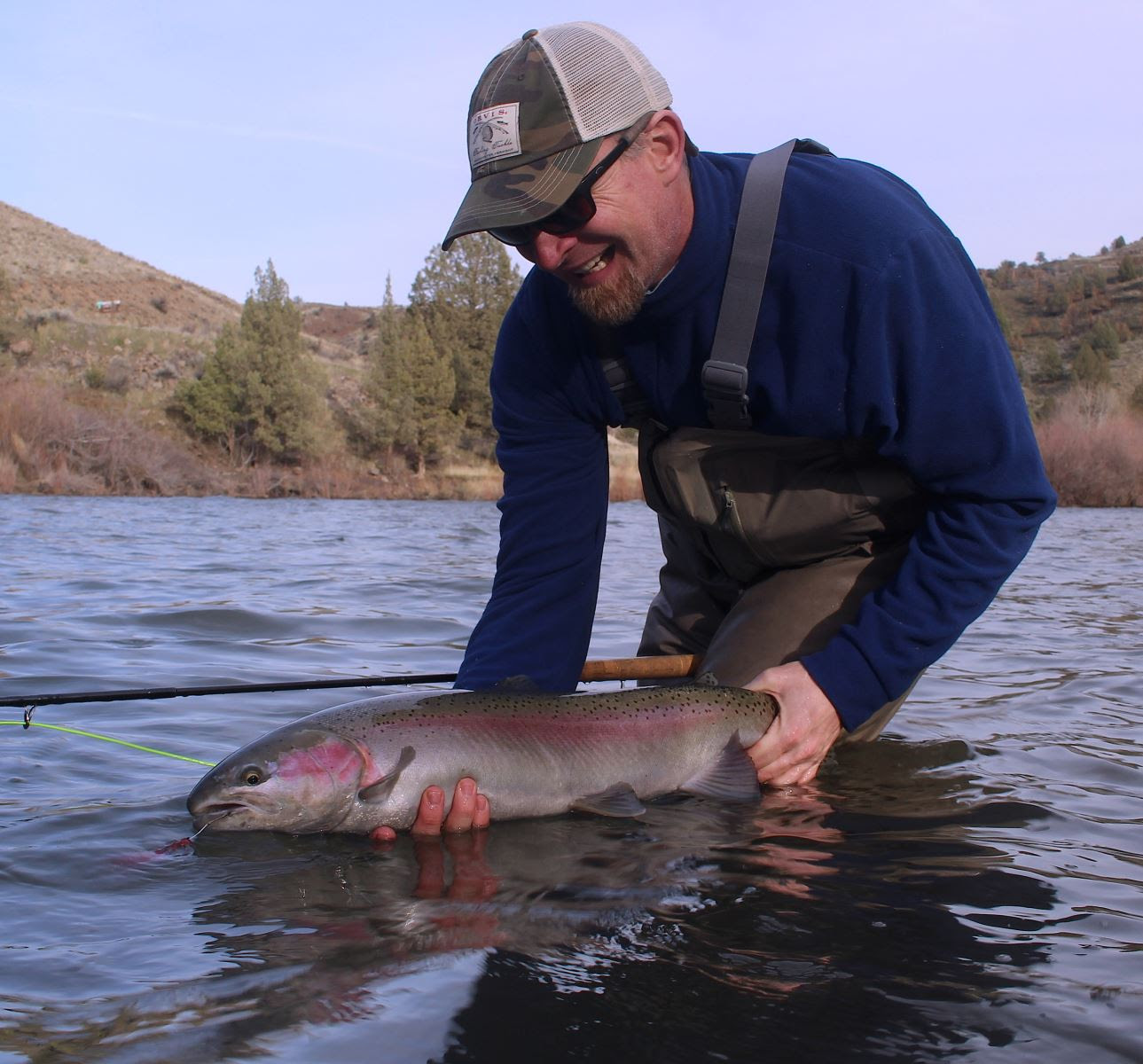
I worked the Bridge Run thoroughly. I caught a fish. He was the definition of "too big for your britches." You gotta love a fish like that.


There was more Chinook activity than the last time I was here. It looked much more like old times.


I backtracked under the bridge and headed upstream to the Glide.


I fished some riffles and runs on the way, but the only fish I saw were defunct salmon.


I worked the Glide over pretty good. But no fish.


It was dusk, and getting dark fast, when I reeled in, crossed the river on a gravel bar, and started my wade downstream to the bridge.


Halfway back I located another well-worn deer path up the bank and clambered out over the roots and stones into an open field.


It was an easy walk back to the truck--on solid ground rather than through the dark, rocky river.


I decided that was my best move of this trip to the river. But I'll be back.