Pages

Showing posts with label Gary Snyder. Show all posts

Monday, May 23, 2016

"6" by Gary Snyder

"Fresh Blackberries" by Jodi McKinney


“In that year, 1914, we lived on the farm
And the relatives lived with us.
A banner year for wild blackberries
Dad was crazy about wild blackberries
No berries like that now.
You know Kitsap County was logged before
The turn of the century—it was easiest of all,
Close to water, virgin timber,
When I was a kid walking about in the
Stumpland, wherever you’d go a skidroad
Puncheon, all overgrown.
We went up one like that, fighting our way through
To its end near the top of a hill:
For some reason wild blackberries
Grew best there. We took off one morning
Right after milking: rode the horses
To a valley we’d been to once before
Hunting berries, and hitched the horses.
About a quarter mile up the old road
We found the full ripe of berrytime—
And with only two pails—so we
Went back home, got Mother and Ruth,
And filled lots of pails. Mother sent letters
To all the relatives in Seattle:
Effie, Aunt Lucy, Bill Moore,
Forrest, Edna, six or eight, they all came
Out to the farm, and we didn’t take pails
Then: we took copper clothes-boilers,
Wash-tubs, buckets, and all went picking.
We were canning for three days.”


"6" by Gary Snyder from Myths and Texts. © New Directions, 1978.

Wednesday, May 11, 2016

"Hay for the Horses" by Gary Snyder


He had driven half the night
From far down San Joaquin
Through Mariposa, up the
Dangerous mountain roads,
And pulled in at eight a.m.
With his big truckload of hay
          behind the barn.
With winch and ropes and hooks
We stacked the bales up clean
To splintery redwood rafters
High in the dark, flecks of alfalfa
Whirling through shingle-cracks of light,
Itch of haydust in the 
               sweaty shirt and shoes.
At lunchtime under Black oak
Out in the hot corral,
--The old mare nosing lunchpails,
Grasshoppers crackling in the weeds--
"I'm sixty-eight" he said,
"I first bucked hay when I was seventeen.
I thought, that day I started,
I sure would hate to do this all my life.
And dammit, that's just what
I've gone and done."

From Riprap and Cold Mountain Poems by Gary Snyder, published by North Point Press.
Copyright © 1958, 1959, 1965 Gary Snyder.

____________________

From The Writer's Almanac:

An Interview with Gary Snyder

Gary Snyder was born in San Francisco. As a teenager, he wrote articles for the mountain-climbing club’s magazine and his high school newspaper, and then he went to Reed College, where he started reading Asian poetry. In the summers, he worked in logging camps, on trail crews, and as a fire lookout in the mountains. In 1955, he worked at Yosemite National Park on the trail crew. He said: “I had given up on poetry. … Then I got out there and started writing these poems about the rocks and blue jays. I looked at them. They didn’t look like any poems that I had ever written before. So I said, these must be my own poems.” They became his first book, Riprap (1959). That same year, he read with Allen Ginsberg at the famous October Sixth Gallery Reading where Ginsberg read “Howl” for the first time, and the two poets became lifelong friends. Snyder became a hero of the counterculture when Jack Kerouac published the book The Dharma Bums (1958), whose hero, Japhy Ryder, is based on Snyder.
For over a decade, Snyder spent most of his time studying Zen Buddhism in Japan. He has published more than 20 books of poetry and prose, includingAxe Handles (1983), Mountains and Rivers Without End (1997), and Turtle Island (1974), which won the Pulitzer Prize in 1975. He has also translated poetry, taught English at the University of California, Davis, and is respected environmental activist and thinker. Snyder has lived in the same house since 1970. The house was built by hand on a 100-acre plot of land in California’s Sierra Nevada. His most recent books include Nobody Home: Writing, Buddhism, and Living in Places (2014) and This Present Moment: New Poems(2015).

Read the interview →

Sunday, January 10, 2016

"By Frazier Creek Falls" by Gary Snyder

Frazier Creek Falls, Plumas National Forest, California
Photo: Robert Fike


Standing up on lifted, folded rock
looking out and down—

The creek falls to a far valley.
hills beyond that
facing, half-forested, dry
—clear sky
strong wind in the
stiff glittering needle clusters
of the pine—their brown
round trunk bodies
straight, still;
rustling trembling limbs and twigs

listen.

This living flowing land
is all there is, forever

We are it
it sings through us—

We could live on this Earth
without clothes or tools!


"By Frazier Creek Falls" by Gary Snyder from No Nature. © Pantheon Books, 1992.

Monday, November 9, 2015

"Makings" by Gary Snyder


I watched my father’s friends
Roll cigarettes, when I was young
Leaning against our black tarpaper shack.
The wheatstraw grimy in their hands
Talking of cars and tools and jobs
Everybody out of work.
the quick flip back
And thin lick stick of the tongue,
And a twist, and a fingernail flare of match.
I watched and wished my overalls
Had hammer-slings like theirs.
The war and after the war
With jobs and money came,
My father lives in a big suburban home.
It seems like since the thirties
I’m the only one stayed poor.
It’s good to sit in the
Window of my shack,
Roll tan wheatstraw and tobacco
Round and smoke.

"Makings" by Gary Snyder from No Nature. © Pantheon Books 1992. 

Saturday, May 9, 2015

"Above Pate Valley" by Gary Snyder

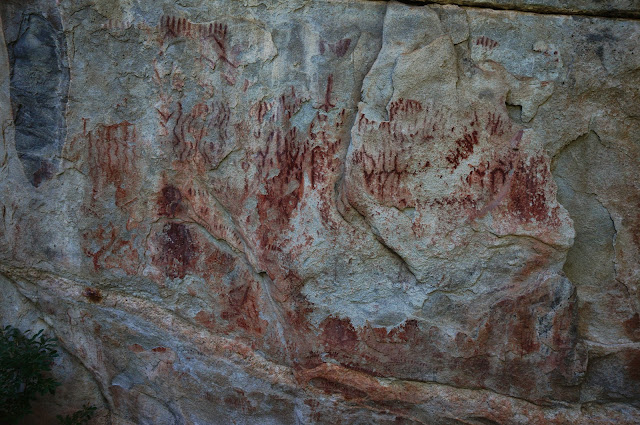
Pictographs, Pate Valley, Yosemite National Park


We finished clearing the last
Section of trail by noon,
High on the ridge-side
Two thousand feet above the creek
Reached the pass, went on
Beyond the white pine groves,
Granite shoulders, to a small
Green meadow watered by the snow,
Edged with Aspen-sun
Straight high and blazing
But the air was cool.
Ate a cold fried trout in the
Trembling shadows. I spied
A glitter, and found a flake
Black volcanic glass-obsidian-
By a flower. Hands and knees
Pushing the Bear grass, thousands
Of arrowhead leavings over a
Hundred yards. Not one good
Head, just razor flakes
On a hill snowed all but summer,
A land of fat summer deer,
They came to camp. On their
Own trails. I followed my own
Trail here. Picked up the cold-drill,
Pick, singlejack, and sack
Of dynamite.
Ten thousand years.


"Above Pate Valley" by Gary Snyder from Riprap and Cold Mountain. © Shoemaker & Hoard Publishers, 2003.

Tuesday, July 29, 2014

"For the Children" by Gary Snyder


The rising hills, the slopes,
of statistics
lie before us,
the steep climb
of everything, going up,
up, as we all
go down.

In the next century
or the one beyond that,
they say,
are valleys, pastures,
we can meet there in peace
if we make it.

To climb these coming crests
one word to you, to
you and your children:

stay together
learn the flowers
go light

"For the Children" by Gary Snyder, from Turtle Island.
© New Directions, 1974.

Wednesday, April 10, 2013

Heads Up: National Park Week

National Park Week is coming. Ranger Hank Mallery is here to sing about it.


And here, from the National Park Week website, is some interesting information:
_________________________________
Each spring, the National Park Service and the National Park Foundation, invite everyone to celebrate National Park Week. This year, from April 20 – 28, YOU are invited to get to know your national parks. 
Did you know…America’s national parks include more than:
  • 84 million acres of spectacular scenery, historic landmarks and cultural treasures
  • 17,000 miles of trails
  • 43,000 miles of shoreline
  • 27,000 historic and prehistoric structures
  • 100 million museum items
  • 12,000 campsites
Join us for National Park Week and hike, learn, share, and give back in the nation’s 401 national parks!

Did you know…that from Monday, April 22 – Friday, April 26, the national parks waive all entrance fees?  So, whether it is your first trip, or the latest of many memorable park experiences, there couldn’t be a better time to get out and explore!
Did you know…that with 401 parks coast-to-coast, every American is less than 100 miles from a national park experience?
______________________

We are fortunate in Washington State to have no less three National Parks, three National Recreation Areas, two National Historical Parks, and one National Historical Reserve.


Our closest park is North Cascades National Park, founded in 1968.


I learned something wonderful about the park as I was looking things up for this post. I learned that it was here, in 1953, on one of the peaks now incorporated in the park, that Gary Snyder wrote one of my all-time favorite poems:

MID-AUGUST AT SOURDOUGH
MOUNTAIN LOOKOUT

Down valley a smoke haze
Three days heat, after five days rain
Pitch glows on the fir-cones
Across rocks and meadows
Swarms of new flies.

I cannot remember things I once read
A few friends, but they are in cities.
Drinking cold snow-water from a tin cup
Looking down for miles
Through high still air.

He appears in this recent video--briefly--and actually reads from the poem--but only a fragment. That's like exhibiting a random square-foot fragment of a Van Gogh or a Picasso. But, be that as it may, it was good to make the connection between him and North Cascades.


So I'm thinking it would be nice to head up to the park to help celebrate National Park Week, but we'll have to see whether the road will be open by then. Highway 20, the northern leg of the North Cascades Highway, and our best route, is closed every winter. Many years it isn't open again until sometime in May.

It's those pesky avalanche areas.


Here's what the DOT says about it:

We cannot physically keep the North Cascades Highway open all winter. The North Cascades Highway has avalanche chutes that are more than 2,000 feet long. Even if a couple inches of snow slides, the chutes can dump a 20-foot deep avalanche on the highway in a matter of minutes. (The avalanche chutes on Stevens and Snoqualmie are all well under 1,000 feet long.) Couple that with the fact that the highway has among the most avalanche chutes of any mountain pass highway in the country and there's no way anyone could provide a safe highway, short of putting the route in a tunnel (which would eliminate all of its appeal, even if someone had that much money).

But the good news is that every spring a crew from the west and a crew from the east start out to break through the snow and open the road. They use Kodiak snowblowers, D-6 Caterpillars, Arctic Cats, road graders, and scoop loaders. This year they started on March 25.


This map shows progress through week 2. This is week 3, though, and the very latest report, from yesterday, puts the west crew past the Swamp Creek Mile Post, and the east crew past Whistler Mountain Mile Post. That's only 5 miles apart! But it also says that a predicted snowfall today could slow them down.


You can follow the progress here. And root them on. They just might break through in time for the big celebration.

Sunday, May 8, 2011

Happy Birthday, Gary

Another of my literary heroes. As a college student suffering from the disconnect with my western roots, I was drawn to his poetry of mountains and pine trees, outer and inner space.


Gary Snyder is a poet, author, scholar, cultural critic, and Professor Emeritus of UC Davis. He graduated from Reed college in Portland, Oregon (where his roommates were poets Lew Welch and Philip Whalen) in 1951. In the Bay Area, Snyder associated with Kenneth Rexroth, Robert Duncan, Philip Whalen, Allen Ginsberg, Jack Kerouac and others who were part of the remarkable flowering of west coast poetry during the fifties. In 1956 he moved to Japan to study Zen Buddhism and East Asian culture. For the last thirty-eight years, he has lived in the northern Sierra Nevada. He divides his time between environmental and cultural issues with a focus on the Sierra Nevada ecosystem, and teaching with a focus on creative writing, ethnopoetics, and bioregional praxis.  He is the author of numerous books of poetry and prose. He has been awarded the Pulitzer prize for poetry (1975) as well as the Bollingen Prize (1997). His selected poems No Nature was a finalist for the National Book Award in 1992.


I'm fine with him teaching "ethnopoetics" and "bioregional praxis." Someone has to do it, I suppose. And I'm sure whoever wrote that bio thought people would be impressed as hell by those terms. (I don't think Snyder wrote it.)


What impressed me about Snyder was something this bio doesn't mention: that in the course of growing up in and wandering around the Pacific Northwest, he had been a fire lookout, a logger, and a seaman. He knew the mountains and forests and waters, and the people who lived in and on and around them, and who made their living off of them. His life had been a praxis of the western experience.


This was and is one of my favorite poems of his, as western and as Zen as I can imagine::


MID-AUGUST AT SOURDOUGH
MOUNTAIN LOOKOUT

Down valley a smoke haze
Three days heat, after five days rain
Pitch glows on the fir-cones
Across rocks and meadows
Swarms of new flies.

I cannot remember things I once read
A few friends, but they are in cities.
Drinking cold snow-water from a tin cup
Looking down for miles
Through high still air.


He was associated with the Beat Generation, knowing and hanging around with the likes of Kerouac, Ginsberg, Ferlinghetti, and Rexroth. But in many ways he was a Hippie before there were Hippies. He was ahead of his time in trying to make sense of the world and experience by seeking spiritual oneness with himself and the Creation.


You know, that's what it was all about in the beginning. It's hard to remember that in this day and age when the word "party" has become a verb and a way of life. But in those days it wasn't just about getting high; it was about getting High, man.


And having fun while doing it:


SMOKEY THE BEAR SUTRA By GARY SNYDER

Once in the Jurassic about 150 million years ago, the Great Sun Buddha in this corner of the Infanite Void gave a discourse to all the assembled elements and energies: to the standing beings, the walking beings, the flying beings, and the sitting beings – even the grasses, to the number of thirteen billion, each one born from a seed, assembled there: a Discourse concerning Enlightenment on the planet Earth
“In some future time, there will be a continent called America. It will have great centers of power called such as Pyramid Lake, Walden Pond, Mt. Rainier, Big Sur, Everglades, and so forth; and powerful nerves and channels such as Columbia River, Mississippi River, and Grand Canyon. The human race in that era will get into troubles all over its head, and practically wreck everything in spite of its own strong intelligent Buddha-nature.”
“The twisting strata of the great mountains and the pulsings of volcanoes are my love burning deep in the earth. My obstinate compassion is schist and basalt and granite, to be mountains, to bring down the rain. In that future American Era I shall enter a new form; to cure the world of loveless knowledge that seeks with blind hunger: and mindless rage eating food that will not fill it.”
And he showed himself in his true form of

SMOKEY THE BEAR

A handsome smokey-colored brown bear standing on his hind legs, showing that he is aroused and watchful.
Bearing in his right paw the Shovel that digs to the truth beneath appearances; cuts the roots of useless attach- ments, and flings damp sand on the fires of greed and war;
His left paw in the mudra of Comradly Display-indicating that all creatures have the full right to live to their limits and that of deer, rabbits, chipmunks, snakes, dandelions, and lizards all grow in the realm of the Dharma;
Wearing the blue work overalls symbolic of slaves and laborers, the countless men oppressed by a civilization that claims to save but often destroys;
Wearing the broad-brimmed hat of the west, symbolic of the forces that guard the wilderness, which is the Natural State of the Dharma and the true path of man on Earth:
all true paths lead through mountains-
With a halo of smoke and flame behind, the forest fires of the kali-yuga, fires caused by the stupidity of those who think things can be gained and lost whereas in truth all is contained vast and free in the Blue Sky and Green Earth of One Mind;
Round-bellied to show his kind nature and that the great earth has food enough for evryone who loves her and trusts her;
Trampling underfoot wasteful freeways and needless suburbs, smashing the worms of capitalism and totalitarianism;
Indicating the task: his followers, becoming free of cars, houses, canned foods, universities, and shoes, master the Three Mysteries of their own Body, Speech, and Mind; and fearlessly chop down the rotten trees and prune out the sick limbs of this country America and then burn the leftover trash.
Wrathful but calm. Austere but Comic. Smokey the Bear will Illuminate those who would help him; but for those who would hinder or slander him…

HE WILL PUT THEM OUT.

Thus his great Mantra:
Namah samanta vajranam chanda maharoshana Sphataya hum traks ham mam
“I DEDICATE MYSELF TO THE UNIVERSAL DIAMOND BE THIS RAGING FURY BE DESTROYED”
And he will protect those who love the woods and rivers, Gods and animals, hobos and madmen, prisoners and sick people, musicians, playful women, and hopeful children:
And if anyone is threatened by advertising, air pollution, television, or the police, they should chant SMOKEY THE BEAR’S WAR SPELL:

DROWN THEIR BUTTS

CRUSH THEIR BUTTS

DROWN THEIR BUTTS

CRUSH THEIR BUTTS

And SMOKEY THE BEAR will surly appear to put the enemy out with his vsjra-shovel.
Now those who recite this Sutra and then try to put it in practice will accumulate merit as countless as the sands of Arizona and Nevada.
Will help save the planet Earth from total oil slick. Will enter the age of harmony of man and nature. Will win the tender love and caresses of men, women, and beasts. Will always have ripened blackberries to eat and a sunny spot under a pine tree to sit at.

AND IN THE END WILL WIN HIGHEST PERFECT ENLIGHTENMENT

…thus we have heard…
(may be reproduced free forever)