Pages

Showing posts with label poetry and poets. Show all posts

Saturday, August 13, 2016

"Almanac" by Lois Parker Edstrom


My grandparents owned the land,
worked the land, bound 
to the earth by seasons of planting 
and harvest. 

They watched the sky, the habits
of birds, hues of sunset, 
the moods of moon and clouds, 
the disposition of air. 
They inhaled the coming season, 
let it brighten their blood 
for the work ahead. 

Soil sifted through their fingers
imbedded beneath their nails 
and this is what they knew; 
this rhythm circling the years. 
They never left their land; 
each in their own time 
settled deeper. 


"Almanac" by Lois Parker Edstrom from Night Beyond Black. © MoonPath Press, 2016.

Wednesday, August 10, 2016

"I Hear You Call, Pine Tree" by Yone Noguchi

A Bat Flying Near a Pine Tree, Issho, 19th Century


I hear you call, pine tree, I hear you upon the hill, by the silent pond
where the lotus flowers bloom, I hear you call, pine tree.
What is it you call, pine tree, when the rains fall, when the winds
blow, and when the stars appear, what is it you call, pine tree?
I hear you call, pine tree, but I am blind, and do not know how to
reach you, pine tree. Who will take me to you, pine tree?

1921. Public Domain.


Note: In Japan the pine tree, or matsu (松の木), symbolizes longevity,
virtue and youth and is often associated with masculinity and power
– prior to the Edo period it was a particularly popular decoration on
samurai armour. The word matsu means waiting for the soul of a god
to descend from Heaven, and in ancient Shinto beliefs, the gods were
said to have ascended to Heaven on a pine tree.

Saturday, August 6, 2016

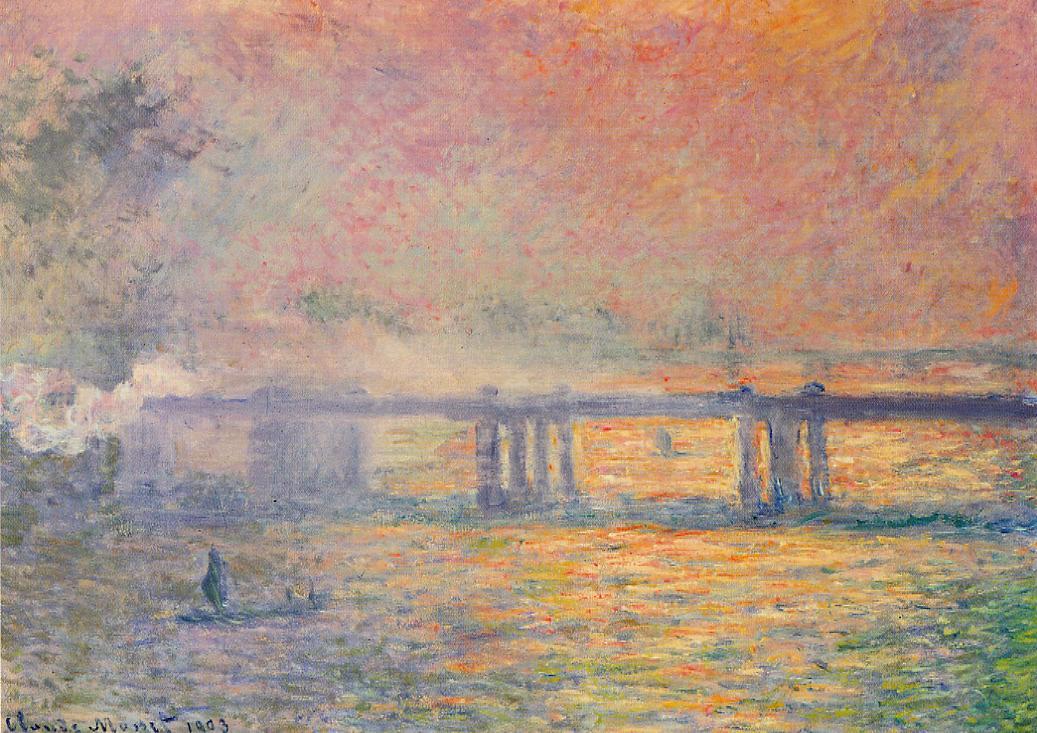
"Bridge" by Jim Harrison

Charing Cross Bridge, London, Claude Monet


Most of my life was spent
building a bridge out over the sea
though the sea was too wide.
I’m proud of the bridge
hanging in the pure sea air. Machado
came for a visit and we sat on the
end of the bridge, which was his idea.


Now that I’m old the work goes slowly.
Ever nearer death, I like it out here
high above the sea bundled
up for the arctic storms of late fall,
the resounding crash and moan of the sea,
the hundred-foot depth of the green troughs.
Sometimes the sea roars and howls like
the animal it is, a continent wide and alive.
What beauty in this the darkest music
over which you can hear the lightest music of human
behavior, the tender connection between men and galaxies.


So I sit on the edge, wagging my feet above
the abyss. Tonight the moon will be in my lap.
This is my job, to study the universe
from my bridge. I have the sky, the sea, the faint
green streak of Canadian forest on the far shore.


"Bridge" by Jim Harrison from Dead Man's Float. © Copper Canyon Press, 2016.

Tuesday, August 2, 2016

"Squall" by Leonora Speyer


The squall sweeps grey-winged across the obliterated hills,
And the startled lake seems to run before it;
From the wood comes a clamor of leaves,
Tugging at the twigs,
Pouring from the branches,
And suddenly the birds are still.

Thunder crumples the sky,
Lightning tears at it.

And now the rain!
The rain--thudding--implacable--
The wind, reveling in the confusion of great pines!

And a silver sifting of light,
A coolness;
A sense of summer anger passing,
Of summer gentleness creeping nearer--
Penitent, tearful,
Forgiven!

1927. Public Domain.

Saturday, July 30, 2016

"Looking at a Lizard" by Barry Spacks

Aboriginal rock art, Northern Tablelands, Australia
Photo: Don Hitchcock


My only purpose this moment
is looking at a lizard.
Does he know he’s not alone?

He breathes with tiny push-ups,
his skin all hairline caverns
soaking up the sun.

I doubt, alive, I’m liable to get
closer to timelessness than this,
looking at a little lizard breathing.


"Looking at a Lizard" by Barry Spacks from Shaping Water. © Gunpowder Press, 2015.

Tuesday, July 26, 2016

"Asphalt" by Al Ortolani


The road crew hired temps
between semesters
to stand beside the hopper
shoveling. The foreman
disliked college students.
He never learned our names,
referenced us by the tools
we carried—Skip and I
were Shovels, scraping the hot
mix into the conveyor.
Ronnie the college drop-out
advanced to Rake.
He followed the paver,
flicking the screed ridge
to a smooth seam.
All summer I shoveled the city
streets, made-do with whatever
shade I could catch. Each day
at five, we cleaned the tools
with diesel and putty knives.
Then we sprayed our boots,
kicking our steel toes against
a bar of rail line. We wet rags
with the diesel and scrubbed
our hands and faces.
Then I drove home, a towel
on the seat, another on the arm rest.
I hung my work clothes
on the fence behind the house.
They appeared capable
of walking off on their own.


"Asphalt" by Al Ortolani from Paper Birds Don't Fly. © NYQ Books, 2016. 

Monday, July 18, 2016

"Visiting Mountains" by Ted Kooser

Ansel Adams
The Tetons and the Snake River, Ansel Adams, 1942


The plains ignore us,
but these mountains listen,
an audience of thousands
holding its breath
in each rock. Climbing,
we pick our way
over the skulls of small talk.
On the prairies below us,
the grass leans this way and that
in discussion;
words fly away like corn shucks
over the fields.
Here, lost in a mountain’s
attention, there’s nothing to say.


"Visiting Mountains" by Ted Kooser from Flying at Night. © University of Pittsburgh Press, 1985.

Wednesday, July 13, 2016

"The Daylight Is Huge" by Amy MacLennan

Sunrise on the Summer Solstice, seen from North Shore of Lake Superior
at Gooseberry Falls State Park, Minnestota,
Photo by Stephen G. Weaver


The daylight is huge.
Five a.m. and the sky already
blushing gray. Mornings so full
of blue the clouds almost sheepish
as they wisp over hills.
High noon only happens in June,
mid-day a tipping point, the scale
weighed down on both sides
with blazed hours. And the evenings—
so drawn out the land lies stunned
by that shambling last light.

"The Daylight is Huge" by Amy MacLennan from The Body, A Tree. © MoonPath Press, 2016. 

Friday, July 8, 2016

Preface to Leaves of Grass, by Walt Whitman

Notebook with trial lines for Leaves of Grass, ca. 1847-1854
Manuscript Division, Library of Congress


This is what you shall do: Love the earth and sun and the animals, despise riches, give alms to every one that asks, stand up for the stupid and crazy, devote your income and labor to others, hate tyrants, argue not concerning God, have patience and indulgence toward the people, take off your hat to nothing known or unknown or to any man or number of men, go freely with powerful uneducated persons and with the young and with the mothers of families, read these leaves in the open air every season of every year of your life, re-examine all you have been told at school or church or in any book, dismiss whatever insults your own soul; and your very flesh shall be a great poem and have the richest fluency not only in its words but in the silent lines of its lips and face and between the lashes of your eyes and in every motion and joint of your body.


Preface to Leaves of Grass by Walt Whitman.

Thursday, July 7, 2016

"Marriage" by Jim Harrison

Civil-final.jpg
Confederate veteran and veteran of the Union Army shake hands at Gettysburg. 


I just remembered a serious argument.
On my seventy-fifth birthday I had the firm sense
that I was a hundred seventy-five. She disagreed.
“Look at your driver’s license,” she said. I said you know
the state of Montana took my license from me. She
went to my briefcase and got out my passport.
“You’re a mere seventy-five,” she said.
I said, “How can you trust the government
in this important matter?” I went to bed
after a couple of drinks believing I was a hundred
seventy-five. In the morning I felt
only seventy-five and apologized at breakfast.
I’d lost a hundred years and felt light,
younger, more energetic. As a boy I saw in Life
magazine photos of the Civil War veterans. I don’t
think there are any left, are there?
They would have to be a hundred seventy-five.
Sometimes I remember aspects of that damnable war.

"Marriage" by Jim Harrison from Dead Man's Float. © Copper Canyon Press, 2016.

Saturday, June 25, 2016

'Ripe Cherries" by Athena Kildegaard

"A Harvest of Death" Gettysburg battlefield, 1863, Matthew Brady (?)

                                                                      I read that the men,
                                                                      on their way to Gettysburg,
                                                                      stopped along the road
                                                                      to pick and eat ripe cherries.

                                                                      That the fruit should not
                                                                      go to waste.

                                                                      That they should take
                                                                      such pleasure before battle.

                                                                      That the oldest among them
                                                                      should shake the trees
                                                                      and the youngest gather
                                                                      the fallen fruit.
                                                                      That they should aim rifles
                                                                      with the taste of cherries
                                                                      against their teeth.


"Ripe Cherries" by Athena Kildegaard from Bodies of Light. © Red Dragonfly Press, 2011.

Saturday, June 11, 2016

"As Kingfishers Catch Fire" by Gerard Manley Hopkins

Photo credit: 500px


                                                      As kingfishers catch fire, dragonflies draw flame;
                                                                As tumbled over rim in roundy wells
                                                                Stones ring; like each tucked string tells, each hung bell’s
                                                      Bow swung finds tongue to fling out broad its name;
                                                      Each mortal thing does one thing and the same:
                                                                Deals out that being indoors each one dwells;
                                                                Selves—goes itself; myself it speaks and spells,
                                                      Crying What I do is me: for that I came.

                                                      I say more: the just man justices;
                                                                Keeps grace: that keeps all his goings graces;
                                                      Acts in God’s eye what in God’s eye he is—
                                                                Christ. For Christ plays in ten thousand places,
                                                      Lovely in limbs, and lovely in eyes not his
                                                                To the Father through the features of men’s faces.


"As Kingfishers Catch Fire" by Gerard Manley Hopkins. Public Domain.

Wednesday, June 8, 2016

"Strawberries" by Paul Martin

Une Fraise de Carpentras, John O'Grady, 2013


It’s ripe strawberries that bring me
to my knees in the garden this morning,

impossibly big and red as those
on the covers of gardening magazines in January

and almost as sweet as the small wild ones
my brother and I picked up on Best’s Hill,

eating more than we dropped into the coffee cans
our mother fitted with wire handles.

If a cloud moved across that blue sky
casting a shadow, I didn’t notice,

the snakes we were warned about
never appeared, and who could see,

even in that brilliant light,
beyond the quiet hills all the way to Vietnam

and the war he’d carry back with him.
Heads down we browsed through the field

until we were filled and drowsy,
sprawled next to each other in the warm grass,

juice smeared across our T-shirts,
our mouths and hands.


"Strawberries" by Paul Martin from Closing Distances. © The Backwaters Press, 2009.

Monday, May 23, 2016

"6" by Gary Snyder

"Fresh Blackberries" by Jodi McKinney


“In that year, 1914, we lived on the farm
And the relatives lived with us.
A banner year for wild blackberries
Dad was crazy about wild blackberries
No berries like that now.
You know Kitsap County was logged before
The turn of the century—it was easiest of all,
Close to water, virgin timber,
When I was a kid walking about in the
Stumpland, wherever you’d go a skidroad
Puncheon, all overgrown.
We went up one like that, fighting our way through
To its end near the top of a hill:
For some reason wild blackberries
Grew best there. We took off one morning
Right after milking: rode the horses
To a valley we’d been to once before
Hunting berries, and hitched the horses.
About a quarter mile up the old road
We found the full ripe of berrytime—
And with only two pails—so we
Went back home, got Mother and Ruth,
And filled lots of pails. Mother sent letters
To all the relatives in Seattle:
Effie, Aunt Lucy, Bill Moore,
Forrest, Edna, six or eight, they all came
Out to the farm, and we didn’t take pails
Then: we took copper clothes-boilers,
Wash-tubs, buckets, and all went picking.
We were canning for three days.”


"6" by Gary Snyder from Myths and Texts. © New Directions, 1978.

Saturday, May 14, 2016

"Letter Home" by Pamela Alexander

Crow1916. Watanabe Seitei.


I can't write you because everything's
wrong. Before dawn, crows swim
from the cedars: black coffee calls them down,
its bitter taste in my throat as they circle,
raucous, huge. Questions with no
place to land, they cruise yellow air
above crickets snapping
like struck matches. My house on fire, crows

are the smoke. You've never left me.
When you crossed the river you did not
call my name. I stood in tall grass
a long time, listening to birds
hidden in reeds, their intricate songs.

The grass will burn, the wrens,
the river and the rain that falls on it.
I can go nowhere else: everything
I cannot bear is here.

I must listen deeper. Sharpen my knife.
Something has changed the angles
of trees, their color. Do not wait to hear
from me. I cannot write to you
because this is what I will say.

From Slow Fire by Pamela Alexander. Copyright © 2007 by Pamela Alexander. 

Friday, May 13, 2016

"Horses" by Jim Harrison

Faith. Katya Hannula


In truth I am puzzled most in life
by nine horses.

I’ve been watching them for eleven weeks
in a pasture near Melrose.

Two are on one side of the fence and seven
on the other side.

They stare at one another from the same places
hours and hours each day.

This is another unanswerable question
to haunt us with the ordinary.

They have to be talking to one another
in a language without a voice.

Maybe they are speaking the wordless talk of lovers,
sullen, melancholy, jubilant.

Linguists say that language comes after music
and we sang nonsense syllables

before we invented a rational speech
to order our days.

We live far out in the country where I hear
creature voices night and day.

Like us they are talking about their lives
on this brief visit to earth.

In truth each day is a universe in which
we are tangled in the light of stars.

Stop a moment. Think about these horses
in their sweet-smelling silence.

"Horses" by Jim Harrison from Songs of Unreason. © Copper Canyon Press, 2011.

Wednesday, May 11, 2016

"Hay for the Horses" by Gary Snyder


He had driven half the night
From far down San Joaquin
Through Mariposa, up the
Dangerous mountain roads,
And pulled in at eight a.m.
With his big truckload of hay
          behind the barn.
With winch and ropes and hooks
We stacked the bales up clean
To splintery redwood rafters
High in the dark, flecks of alfalfa
Whirling through shingle-cracks of light,
Itch of haydust in the 
               sweaty shirt and shoes.
At lunchtime under Black oak
Out in the hot corral,
--The old mare nosing lunchpails,
Grasshoppers crackling in the weeds--
"I'm sixty-eight" he said,
"I first bucked hay when I was seventeen.
I thought, that day I started,
I sure would hate to do this all my life.
And dammit, that's just what
I've gone and done."

From Riprap and Cold Mountain Poems by Gary Snyder, published by North Point Press.
Copyright © 1958, 1959, 1965 Gary Snyder.

____________________

From The Writer's Almanac:

An Interview with Gary Snyder

Gary Snyder was born in San Francisco. As a teenager, he wrote articles for the mountain-climbing club’s magazine and his high school newspaper, and then he went to Reed College, where he started reading Asian poetry. In the summers, he worked in logging camps, on trail crews, and as a fire lookout in the mountains. In 1955, he worked at Yosemite National Park on the trail crew. He said: “I had given up on poetry. … Then I got out there and started writing these poems about the rocks and blue jays. I looked at them. They didn’t look like any poems that I had ever written before. So I said, these must be my own poems.” They became his first book, Riprap (1959). That same year, he read with Allen Ginsberg at the famous October Sixth Gallery Reading where Ginsberg read “Howl” for the first time, and the two poets became lifelong friends. Snyder became a hero of the counterculture when Jack Kerouac published the book The Dharma Bums (1958), whose hero, Japhy Ryder, is based on Snyder.
For over a decade, Snyder spent most of his time studying Zen Buddhism in Japan. He has published more than 20 books of poetry and prose, includingAxe Handles (1983), Mountains and Rivers Without End (1997), and Turtle Island (1974), which won the Pulitzer Prize in 1975. He has also translated poetry, taught English at the University of California, Davis, and is respected environmental activist and thinker. Snyder has lived in the same house since 1970. The house was built by hand on a 100-acre plot of land in California’s Sierra Nevada. His most recent books include Nobody Home: Writing, Buddhism, and Living in Places (2014) and This Present Moment: New Poems(2015).

Read the interview →

Wednesday, May 4, 2016

"The Lilies" by Wendell Berry

Yellow Trout Lilies (Erythronium americanum)*


Hunting them, a man must sweat, bear
the whine of a mosquito in his ear,
grow thirsty, tired, despair perhaps
of ever finding them, walk a long way.
He must give himself over to chance,
for they live beyond prediction.
He must give himself over to patience,
for they live beyond will. He must be led
along the hill as by a prayer.
If he finds them anywhere, he will find
a few, paired on their stalks,
at ease in the air as souls in bliss.
I found them here at first without hunting,
by grace, as all beauties are first found.
I have hunted and not found them here.
Found, unfound, they breathe their light
into the mind, year after year.

"The Lilies" by Wendell Berry from New Collected Poems. © Counterpoint, 2012.


*The yellow (Erythronium americanum) and white (E. albidum) Trout lilies are synonymous with early spring ephemeral woodland wildflowers. These small (4 - 6" tall) members of the lily family can put on quite a show when a cluster of them is in full flower. These lilies take seven years to mature and when mature have two mottled basal leaves. The flowers have six tepals (three sepals and three petals) and open during the day (to the extent that they are recurved when fully open) and close at night (to protect the pollen on the showy reddish or yellow anthers.) These are deep-rooted plants and roots can go 8" deep and highly organic or sandy-loam soils are required for these species to thrive. Because these plants flower so early (often in March) the leaves disappear often by the first of May.
Trout lilies are often called Fawn lilies (due to the mottled or spotted leaves and the appearance that resembles a fawn's ears) or Dog-tooth violets because the corms supposedly resemble a dog's tooth and the flowers resemble violets. The name Trout lily is given because of the mottled leaves and the blooming of the flowers during trout fishing season. It is sometimes called Adder's tongue because of the tongue-like flower shape of the flowering shoot as it emerges in the spring and resembles the open mouth of a snake. Both species are found across the state of Kentucky and are common. Supposedly the corm is edible and tastes like a cucumber.
By Dr. Thomas Barnes, from Kentucky Native Plant and Wildlife.

Wednesday, April 20, 2016

Ted Kooser Interview

Jim Harrison has been a popular poet on this blog. His recent death prompted a spike in blog hits as people sought out his poetry.

One of Harrison's poems I had posted just days before his death is "Kooser called from Nebraska to say he'd found..." Maybe some wondered who the "Kooser" is immortalized in Harrison's poem.

Well, here he is, fellow-poet and friend Ted Kooser. The Writer's Almanac recently posted this interview. You'll find Kooser to be another voice speaking from the calm quiet heart of the chaos around us.


Ted Kooser was born in Ames, Iowa, in 1939. Like Wallace Stevens before him, he took a job in the insurance business, where he worked for many years. He would get up early and write poems for an hour and a half before he went to work. By the time he retired in 1999, Kooser had published seven books of poetry, including Not Coming to Be Barked At (1976), One World at a Time (1985), and Weather Central (1994). He resigned himself to being a relatively unknown poet, but he continued to write every morning. Then, in 2004, he got a phone call informing him that he had been chosen as poet laureate of the United States. He said: “I was so staggered I could barely respond. The next day, I backed the car out of the garage and tore the rearview mirror off the driver’s side.”
Kooser served as U.S. poet laureate from 2004 to 2006, one of the first poet laureates to be selected from the Great Plains, and during that time, his book Delights & Shadows (2005) won the Pulitzer Prize for poetry. He also began a weekly newspaper column called “American Life in Poetry.” His goal was to introduce simple poems about ordinary subjects to people who might not otherwise read poetry. He lives on a 62-acre spread near Lincoln, Nebraska, with his wife, Kathleen Rutledge. His latest collection, Splitting an Order, was published by Copper Canyon Press in 2014.

Wednesday, April 13, 2016

"April in Maine" by May Sarton

"Willard's Coat" by Andrew Wyeth, 1968


The days are cold and brown,
Brown fields, no sign of green,
Brown twigs, not even swelling,
And dirty snow in the woods.

But as the dark flows in
The tree frogs begin
Their shrill sweet singing,
And we lie on our beds
Through the ecstatic night,
Wide awake, cracked open.

There will be no going back.


"April in Maine" by May Sarton from Collected Poems. © W.W. Norton & Company, 1993.