Pages

Showing posts with label snow. Show all posts

Thursday, January 28, 2016

ARCTIC

ARCTIC | Timelapse from Riku Karjalainen on Vimeo.
http://www.rikukarjalainen.com/
4K/UHD version: https://youtu.be/NfumX8BIWlQ
ARCTIC shows the freezing and at the same time the beautiful conditions that Finnish winter has to offer. I’ve never had the time to work on bigger projects during winter, so this film consists of different sequences filmed during current and last winter. The clips are filmed in: Pallas-Yllästunturi National Park, Riisitunturi National Park, Kivesvaara and Paltaniemi.
Soundtrack: “Malchus” by James Everingham
Equipment:
Canon 600D, Canon 700D & Sony A7S
Samyang 24mm, Samyang 16mm, Canon 24-105mm, Canon 100-400mm & Tokina 11-16mm
DIY slider with Emotimo TB3

Saturday, January 9, 2016

"Snow-Flakes" By Henry Wadsworth Longfellow

From "Baika Jo = The Plum Blossom Album" Baikan Okada, 1808


Out of the bosom of the Air,
      Out of the cloud-folds of her garments shaken,
Over the woodlands brown and bare,
      Over the harvest-fields forsaken,
            Silent, and soft, and slow
            Descends the snow.

Even as our cloudy fancies take
      Suddenly shape in some divine expression,
Even as the troubled heart doth make
      In the white countenance confession,
            The troubled sky reveals
            The grief it feels.

This is the poem of the air,
      Slowly in silent syllables recorded;
This is the secret of despair,
      Long in its cloudy bosom hoarded,
            Now whispered and revealed
            To wood and field.

Monday, January 4, 2016

Wednesday, December 30, 2015

The Beauty of the Waning Year

A little light broke through the overcast yesterday, briefly colorizing a monochromatic world, and emphasizing the beauty of the waning year.

Monday, August 31, 2015

Henry's Fork Report: The Last Day

It was the seventh and last day of the trip. God rested on the seventh day. I went fishing.

It had been a cold night. There was frost everywhere when I crawled out of the tent. When I arrived at the Back Channel I was not too surprised to glimpse snow up in the high country.


Down here, though, it was pretty nice. There was no wind, and the sun soon melted the frost and warmed the air. I shed my jacket.


I had high hopes for the Back Channel. It would be a sign of cosmic favor to revisit halcyon days of yore and catch a good fish here on the holy water. I looked carefully for rises, walking along the bank to cover the water. Nothing happening--yet.

I sat down on the bank and had a cup of coffee. Soon little black caddis danced around me. Harbingers, I thought. I walked the bank, came back, sat down, and had another cup of coffee.


I waited for a long time. Then it happened as it should happen. First I noticed PMD's drifting through my reflection in the water--not a lot, but enough. Then I heard the first rise. Then I saw a rise. Then I saw several fish rising together. Finally I waded out. Time to begin.

I waded carefully and quietly. Of the rises I saw, most were erratic. Then I identified two fish who were now working steadily in place. One was to my left, and fairly close; the other was to my right and farther away, over in front of a little island.

I went right. This has been a propitious island in years past. More than once we have caught big fish here by targeting little rises.

I made my way to within ten feet of the rise, slightly behind the fish. I had the Harrop PMD on, and began to cast. I got a good drift, then another, the fish rising steadily. Then another...maybe I need to go a little bit farther... And the fish sipped in the fly.

He took off downstream to my left. It was a lovely dance we made, as he would zing line off the reel, and I would slowly regain it, all the time bringing him closer.

I forgot to tell you that I didn't have a net. The evening before, right after I had hooked the fish that shot out of the river like a rocket, the net was dangling in the current on my casting side. So I had grabbed it and tossed it around my back to the other side. Imagine my surprise when it came floating past me and headed downriver toward the Snake. I cast my line over it, and the fly ticked it but couldn't stop it. Later I checked the lanyard and nothing was broken or had come loose. A case of the river twisting and turning and picking my pocket.

So now I had some concern about landing this fish. I brought it in close for a photo in case I wouldn't be able to take another.


When I finally put my hand under him, though, he had decided to be stoic about the whole thing. Another beautiful Henry's Fork rainbow.


I released him and watched him swim away, then stood up and looked around for my next target. The river was quiet. I couldn't see a single rise, and the insects on the surface had thinned. I waded back to the bank and had another cup of coffee. By the time I screwed the cup back onto the old Stanley it was clear the morning on the Back Channel was over.

It was also clear what a perfect morning it had been.


I hiked out and drove back to the Last Chance stretch that had given me so much pleasure the afternoon before. There was nothing happening when I arrived, so I had some lunch while enjoying the un-summerlike view.


Then it was time for a stroll. I geared up and walked upstream along the bank.


I was delighted to find just what I was looking for. In the riffle behind this rock I found a steady riser. I watched him for awhile to make sure he was determined, and he was.


So I walked downstream a ways, waded in, and carefully made my way to a casting position ten feet or so to the left of and behind the fish. I showed him that lucky PMD, and on the fourth cast he took it, and I hooked him. He was a heavy fish. I can't say he was the biggest I had hooked, but he fought like it. He was determined, alright.

I still didn't have a net, so I was trying to work him into the soft water behind the rock. Still, I was nervous when I got him close enough to try to land him. Maybe that was the fatal flaw: I hesitated just long enough for him to lunge into the current and separate himself from the hook.


But what an exhilarating lunch hour.

I walked back to the van looking for more risers, but there were none. I resumed my routine of the day before, waiting and walking the bank.


A hatch began; caddis were coming off in waves. But they were in the trees and grass--they would billow out when you brushed past--and not on the water.


It was a long afternoon of waiting for the fish to show themselves. They never did.


As evening fell, I geared up again and waded out in one more effort to make something happen, or at least to be there if something happened of its own accord. I threw a variety of flies: bead head nymphs, soft hackles, and, of course caddis, dry and wet. I caught the smallest fish of the trip--of the year, I expect.


And I caught one more small fish. I felt as though I was holding the shining future in my hand.


Then I watched the day come to an end.


Back at the campground I lit the ritual Mark Memorial Campfire.


Then sat by the fire for a long time, gazing into the embers, then the moonlight, then the embers, until I finally found myself drifting off in the tent, watching as another Henry's Fork experience faded to black.

Thursday, March 12, 2015

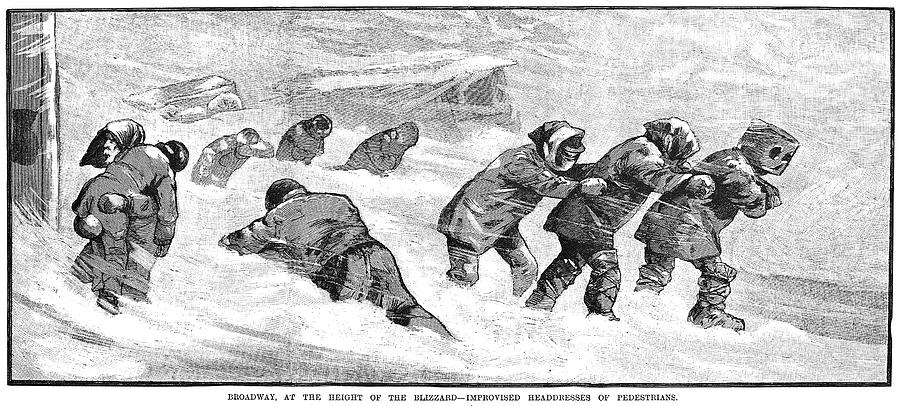
The Great Blizzard of 1888

Here's a fascinating bit of history for today from the The Writer's Almanac. (Text from The Writer's Almanac; photos from archives.) Guess we'd better not get too smug about the balmy March days we've been having. You never know.


Today is the anniversary of the Great Blizzard of 1888, a storm that dumped up to 50 inches of snow along the East Coast from Montreal to Washington, D.C. Four hundred people died in the storm, more than 200 of them from New York City, which was hit particularly hard.


Most storms in the Northeast begin with a cold air mass, often centered over New England, but this time that didn't happen. The days before the storm were mild, with temperatures in the 40s and spring seemingly just around the corner. Two days before the storm was a warm and sunny Saturday, and New Yorkers walked outside, enjoying the greening grass and budding trees. They went shopping or lined up for the opening Barnum & Bailey Circus parade in Manhattan. Sunday March 11th was overcast, with a midday temperature of 42 degrees. The U.S. Army Signal Corps in Washington, D.C., was the go-to weather service, and they were closed on Sundays to observe the Sabbath. However, they had left behind their weather prediction for the coming days: "Fresh to brisk winds, with rain, will prevail, followed by colder brisk westerly winds and fair weather throughout the Atlantic states."


On Sunday afternoon, the rain came and the temperature slowly began to drop. It reached freezing just after midnight, and the rain turned to snow. The wind speed rose, with gusts of up to 80 mph. By Monday morning, everything in New York City was chaos. Walking in the snow and wind was dangerous, and all trains stopped - one derailed and killed several people. Debris flew through the air. By evening, the temperature was in the single digits. The city's 6,900 electric lines all stopped working, so no one had telephone or telegraph access. Fancy hotels filled their lobbies with cots for stranded civilians. All stores were closed, mail was stopped, and the city was more or less shut down. The snow drifts were up to 20 feet high, and many of the people who died in the storm were found buried in them. The East River was so blocked with ice that thousands of people treated it like a bridge and walked right across between Brooklyn and Manhattan. After the police realized what was happening they started blocking pedestrians, fearing more deaths.


In its account of the blizzard on March 13thThe New York Times noted that the day before, the usual morning vendors had been missing: milkmen, newspaper boys, and bakers. The reporter wrote: "Thackeray says that it is the small ills of life that worry the most, and probably thousands of New-Yorkers yesterday morning - good, steady churchgoing heads of families when they had to get through their breakfasts without their favorite newspaper, their hot buttered roll, and their fragrant coffee enriched with the boiling milk began to seriously question whether life was worth living after all, with all those trials and tribulations to undergo."


The Great Blizzard of 1888 caused some huge infrastructure changes in New York City. The above-ground electric lines, gas and water lines, and transit rails not only failed to work during the storm, but they also became a liability, with lines flying through the air, electricity exposed directly to snow and water, and trains derailing. Immediately after the storm, the New-York Tribune wrote an article pressing for a below-ground subway, and the city formulated a plan a few years later.