Pages

Showing posts with label poetry. Show all posts

Monday, November 9, 2015

"Makings" by Gary Snyder


I watched my father’s friends
Roll cigarettes, when I was young
Leaning against our black tarpaper shack.
The wheatstraw grimy in their hands
Talking of cars and tools and jobs
Everybody out of work.
the quick flip back
And thin lick stick of the tongue,
And a twist, and a fingernail flare of match.
I watched and wished my overalls
Had hammer-slings like theirs.
The war and after the war
With jobs and money came,
My father lives in a big suburban home.
It seems like since the thirties
I’m the only one stayed poor.
It’s good to sit in the
Window of my shack,
Roll tan wheatstraw and tobacco
Round and smoke.

"Makings" by Gary Snyder from No Nature. © Pantheon Books 1992. 

Wednesday, November 4, 2015

"The Night Migrations" by Louise Gluck

"Night Reflections" Robert Kipness 1969


This is the moment when you see again
the red berries of the mountain ash
and in the dark sky
the birds’ night migrations.

It grieves me to think
the dead won’t see them-
these things we depend on,
they disappear.

What will the soul do for solace then?
I tell myself maybe it won’t need
these pleasures anymore;
maybe just not being is simply enough,
hard as that is to imagine.


"The Night Migrations" by Louise Glück from Averno. © Farrar, Straus and Giroux, 2006.

Saturday, May 9, 2015

"Above Pate Valley" by Gary Snyder

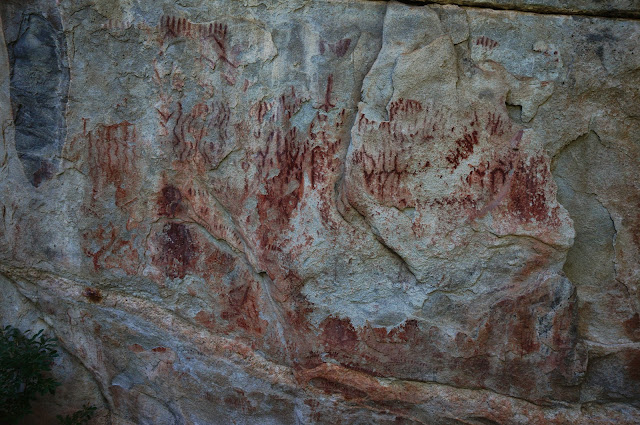
Pictographs, Pate Valley, Yosemite National Park


We finished clearing the last
Section of trail by noon,
High on the ridge-side
Two thousand feet above the creek
Reached the pass, went on
Beyond the white pine groves,
Granite shoulders, to a small
Green meadow watered by the snow,
Edged with Aspen-sun
Straight high and blazing
But the air was cool.
Ate a cold fried trout in the
Trembling shadows. I spied
A glitter, and found a flake
Black volcanic glass-obsidian-
By a flower. Hands and knees
Pushing the Bear grass, thousands
Of arrowhead leavings over a
Hundred yards. Not one good
Head, just razor flakes
On a hill snowed all but summer,
A land of fat summer deer,
They came to camp. On their
Own trails. I followed my own
Trail here. Picked up the cold-drill,
Pick, singlejack, and sack
Of dynamite.
Ten thousand years.


"Above Pate Valley" by Gary Snyder from Riprap and Cold Mountain. © Shoemaker & Hoard Publishers, 2003.

Saturday, February 21, 2015

"Out of the Stump Rot, Something" by Mary Oliver


Out of the stump rot
something
glides forward
that is not a rope,

unless a rope has eyes,
lips,
tongue like a smack of smoke,
body without shoulders.

Thus: the black snake
floating
over the leaves
of the old year

and down to the pond,
to the green just beginning
to fuzzle out of the earth,
also, like smoke.

If you like a prettiness,
don't come here.
Look at pictures instead,
or wait for the daffodils.

This is spring,
by the rattled pond, in the shambled woods,
as spring has always been
and will always be

no matter what we do
in the suburbs.
The matted fur,
the red blood,

the bats unshuttering
their terrible faces,
and black snake
gliding across the field

you think you own.
Long neck, long tail.
Tongue on fire.
Heart of stone.

"Out of the Stump Rot, Something" by Mary Oliver, from A Thousand Mornings, 2012.

Wednesday, February 18, 2015

"I Have Decided' by Mary Oliver


I have decided to find myself a home
in the mountains, somewhere high up
where one learns to live peacefully in
the cold and the silence. It's said that
in such a place certain revelations may
be discovered. That what the spirit
reaches for may be eventually felt, if not
exactly understood. Slowly, no doubt. I'm
not talking about a vacation.

Of course at the same time I mean to
stay exactly where I am.

Are you following me?


"I Have Decided" by Mary Oliver, from A Thousand Mornings, 2012. 

Sunday, February 8, 2015

"Watching Sandhill Cranes" by William Stafford


Spirits among us have departed--friends,
relatives, neighbors: we can't find them.
If we search and call, the sky merely waits.
Then some day here come the cranes
planing in from cloud or mist--sharp,
lonely spears, awkwardly graceful.
They reach for the land; they stalk
the ploughed fields, not letting us near,
not quite our own, not quite the world's.


People go by and pull over to watch. They
peer and point and wonder. It is because
these travelers, these far wanderers,
plane down and yearn in a reaching
flight. They extend our life,
piercing through space to reappear
quietly, undeniably, where we are.


"Watching Sandhill Cranes" by William Stafford, from Even In Quiet Places. © Confluence Press, 1996.

Wednesday, January 14, 2015

"Geese" by Faith Shearin

"On Winter Winds" by Morten E. Solberg


A gaggle of geese return to our street each winter
while migrating from one place to another.
They arrive in January, around my husband’s birthday,

and I am surprised to find them behind our house,
honking like cab drivers in traffic. Most leave with
babies but one pair can’t manage to have any;

I’ve watched them sit for years on a wet nest of death,
warming unhappiness. It is only when the other
geese swim past them, proudly displaying

a line of live chicks, that they realize they have
failed again, their eggs silent beneath the love
of their feathers. My neighbors and I don’t agree

on much but we all watch these geese from our
windows, with binoculars sometimes, our breakfast
growing cold on the table. We wish the unsuccessful

ones would have a season of luck, their eggs healthy
and well placed, for each of us has known the pleasure
of spring, the way it feels for something closed

to open: the soft, heavenly weather of arrival.


"Geese" by Faith Shearin from Moving the Piano. © Stephen F. Austin State University Press, 2011.

Sunday, December 28, 2014

"Winter Grace" by Patricia Fargnoli

"Aurora Borealis"
Hand-lifted woodblock print by Eric K. Nolan.


If you have seen the snow
under the lamppost
piled up like a white beaver hat on the picnic table
or somewhere slowly falling
into the brook
to be swallowed by water,
then you have seen beauty
and know it for its transience.
And if you have gone out in the snow
for only the pleasure
of walking barely protected
from the galaxies,
the flakes settling on your parka
like the dust from just-born stars,
the cold waking you
as if from long sleeping,
then you can understand
how, more often than not,
truth is found in silence,
how the natural world comes to you
if you go out to meet it,
its icy ditches filled with dead weeds,
its vacant birdhouses, and dens
full of the sleeping.
But this is the slowed-down season
held fast by darkness
and if no one comes to keep you company
then keep watch over; your own solitude.
In that stillness, you will learn
with your whole body
the significance of cold
and the night,
which is otherwise always eluding you.


"Winter Grace" by Patricia Fargnoli, from Winter. © Hobblebush Books, 2013. 

Wednesday, December 24, 2014

"Sonnet in the Shape of a Potted Christmas Tree" by George Starbuck

*
O
fury-
bedecked!
O glitter-torn!
Let the wild wind erect
bonbonbonanzas; junipers affect
frostyfreeze turbans; iciclestuff adorn
all cuckolded creation in a madcap crown of horn!
It’s a new day; no scapegrace of a sect
tidying up the ashtrays playing Daughter-in-Law Elect;
bells! bibelots! popsicle cigars! shatter the glassware! a son born
now
now
while ox and ass and infant lie
together as poor creatures will
and tears of her exertion still
cling in the spent girl’s eye
and a great firework in the sky
drifts to the western hill.

Share this text ...
?
George Starbuck, “Sonnet in the Shape of a Potted Christmas Tree” from The Works: Poems Selected from Five Decades.
Copyright © 2003 by the University of Alabama Press.

Sunday, December 21, 2014

"Winter-Time" by Robert Louis Stevenson

"Winter-Time" illustration from A Child's Garden of Verses,
by Ethel Mars and Maud Hunt Squire.


Late lies the wintry sun a-bed,
A frosty, fiery sleepy-head;
Blinks but an hour or two; and then,
A blood-red orange, sets again.

Before the stars have left the skies,
At morning in the dark I rise;
Ans shivering in my nakedness,
By the cold candle, bathe and dress.

Close by the jolly fire I sit
To warm my frozen bones a bit;
Or with a reindeer-sled, explore
The colder countries round the door.

When to go out, my nurse doth wrap
Me in my comforter and cap;
The cold wind burns my face, and blows
Its frosty pepper up my nose.

Black are my steps on silver sod;
Thick blows my frosty breath abroad;
And tree and house, and hill and lake,
Are frosted like a wedding cake.


From A Child's Garden of Verses, first published in 1902.

Friday, December 19, 2014

"Love for Other Things" by Tom Hennen


It’s easy to love a deer
But try to care about bugs and scrawny trees
Love the puddle of lukewarm water
From last week’s rain.
Leave the mountains alone for now.
Also the clear lakes surrounded by pines.
People are lined up to admire them.
Get close to the things that slide away in the dark.
Be grateful even for the boredom
That sometimes seems to involve the whole world.
Think of the frost
That will crack our bones eventually.


"Love for Other Things" by Tom Hennen, from Darkness Sticks to Everything. © Copper Canyon Press, 2013. 

Sunday, December 7, 2014

"At the Beginning of Winter" by Tom Hennen

"Ice Dawn" Linocut by William Hayes


In the shallows of the river
After one o' clock in the afternoon
Ice still
An eighth of an inch thick.
Night never disappears completely
But moves among the shadows
On the bank
Like a glimpse of fur.
Meanwhile
Trees
Grass
Flies and spiderwebs
Appear alone in the flat air.
The naked aspens stand like children
Waiting to be baptized
And the goldenrod too is stripped down
To its bare stalk
In the cold
Even my thoughts
Have lost their foliage.


"At the Beginning of Winter" by Tom Hennen, from Looking Into The Weather. © Westerheim Press, 1983.

Thursday, December 4, 2014

"This Winter Worse Than Most" by Madelyne Camrud

"Twilight" Anna Syperek

At night I awaken and listen

to the house creak, its boards sharpening

in the cold. Days we stay inside,

looking out the window,

and wonder at a world so deep

into temperature. A nuthatch

tweaks thistle seed from a feeder

suction-cupped to the pane.

In moments like this spent close to glass,

how understandable my life is,

inside the heavy ribs of my navy sweater.

I watch the small bird rise

and light on a high branch.


"This Winter Worse than Most" by Madelyne Camrud, from Oddly Beautiful. © New Rivers Press, 2013.

Monday, December 1, 2014

"Report from the West" by Tom Hennen

"Tetons from Signal Mountain" by Ansel Adams, 1930's


Snow is falling west of here. The mountains have more than a
foot of it. I see the early morning sky dark as night. I won't lis-
ten to the weather report. I'll let the question of snow hang.
Answers only dull the senses. Even answers that are right often
make what they explain uninteresting. In nature the answers
are always changing. Rain to snow, for instance. Nature can
let the mysterious things alone—wet leaves plastered to tree
trunks, the intricate design of fish guts. The way we don't fall
off the earth at night when we look up at the North Star. The
way we know this may not always be so. The way our dizziness
makes us grab the long grass, hanging by our fingertips on the
edge of infinity.


"Report from the West" by Tom Hennen, from Darkness Sticks to Everything. © Copper Canyon Press, 2013.

Friday, November 21, 2014

"I Believe" by Jim Harrison


I believe in steep drop-offs, the thunderstorm across the lake
in 1949, cold winds, empty swimming pools,
the overgrown path to the creek, raw garlic,
used tires, taverns, saloons, bars, gallons of red wine,
abandoned farmhouses, stunted lilac groves,
gravel roads that end, brush piles, thickets, girls
who haven’t quite gone totally wild, river eddies,
leaky wooden boats, the smell of used engine oil,
turbulent rivers, lakes without cottages lost in the woods,
the primrose growing out of a cow skull, the thousands
of birds I’ve talked to all of my life, the dogs
that talked back, the Chihuahuan ravens that follow
me on long walks. The rattler escaping the cold hose,
the fluttering unknown gods that I nearly see
from the left corner of my blind eye, struggling
to stay alive in a world that grinds them underfoot.

--from In Search of Small Gods, Copper Canyon Press, 2010

Wednesday, November 12, 2014

"When I Was Seven" by Liane Ellison Norman

Liverpool, England during the Blitz.


When I Was Seven

the war in Europe moved in on the domed
wooden radio with its gothic front where 
Let's Pretend arrived every Saturday, brought 
to us by Uncle Bill and Cream O' Wheat. 

Nathalie and I conspired to send a bomb 
to Hitler hidden in a bouquet of wild flowers, 
or better, in a jar of mayonnaise: either bomb 
or mayo would kill him. I built cities 

out of dominoes where Hitler lived 
and bombed them flat with other dominoes, 
but he hid under the couch and I fled onto it
so he couldn't grab me by the ankles.


"When I Was Seven" by Liane Ellison Norman,
from Breathing the West: Great Basin Poems© Bottom Dog Press, 2012. 

Tuesday, November 11, 2014

Three Poems by Victor H. Bausch


Draft Notice
3 May 1966
Late afternoon. Friday.
Sacramento simmers
in hundred degree heat.
Mom greets me,
grim news in her voice,

a sorrow I'd heard
a couple months before
at my father's funeral:
the somber sadness from which
she'd never recovered.
For those fleeting mercurial moments
between life and beyond
I'd held dad in my arms.
Heard his death rattle.
Became the man of the house,
rode in an ambulance,
called a Catholic priest,
dealt with the nightmare.
I see the envelope lying
on the hallway table

shrouded in a winding sheet
bearing my name.
I hear the faint sound
of war drums beating,
imagine my mother sobbing
beside her son's coffin.
The fire and smoke of my life
rise higher and higher.
My fate, a booby trap, detonates,
destroys what's left of my fragile world.


Civil War of the Soul
You keep asking the same question
over and over
to those who will not listen:
If it wasn't a civil war,
then why were we fighting
men, women, and children?
Like Kerouac on the road,
a hobo riding the rails,
a saint in search of the Grail,
you separate reality from fantasy,
select Fellini as your point man,
cross over life's invisible line of demarcation,
and remove your Rosencrantz and Guildenstern doubt.
For years you've looked for Viet Nam
after Viet Nam
in the drugs you took
in the alcohol you consumed
until you saw the lie
for what it was.
Now in your early fifties
you know how lemmings feel
going over the cliff,
know how pigs and cattle feel
when they're led down the chute,
know how young men feel
when they're cannon fodder
in another senseless war.
Left alone like a refugee
forced to choose
between two countries
you stave off sadness
and suicide
wrestle the demons
in this civil war of the soul.


What They Wanted
was my soul, my body, my mind.
Instead what they got
was a declaration
to wage war on the war.
In the Nam,
during my relationship
between the manipulated
and the manipulator,
I was nothing more
than U.S. Grade A American meat
used for some bureaucrat's political gain.
Now over thirty years later
in this war of no fronts,
an MIA in my own country,
I sleep lightly,
keep a knife nearby on the night stand,
continue to go on night patrols,
look for an alternative revenge.


Victor H. Bausch is a Reference Librarian, a Viet Nam veteran, a member of Veterans for Peace, and a member of the National Writers Union, Local 7, Santa Cruz/Monterey.

Thursday, November 6, 2014

"Moon" by Frederick Smock


The day lengthens, 
the old earth tips its hat 
to the moon.

The changeful moon 
goes through many phases, 
even in a single night, 

though it is the same 
moon as ever, we know this. 
We are the changes.


"Moon" by Frederick Smock, from The Bounteous World. © Broadstone Brooks, 2013.

Wednesday, November 5, 2014

"Island Cities" by John Updike


You see them from airplanes, nameless green islands 
in the oceanic, rectilinear plains, 
twenty or thirty blocks, compact, but with 
everything needed visibly in place—
the high-school playing fields, the swatch of park 
along the crooked river, the feeder highways,
the main drag like a zipper, outlying malls 
sliced from dirt-colored cakes of plowed farmland.
Small lives, we think—pat, flat—in such tight grids. 
But, much like brains with every crease CAT-scanned, 
these cities keep their secrets: vagaries 
of the spirit, groundwater that floods 
the nearby quarries and turns them skyey blue, 
dewdrops of longing, jewels, boxed in these blocks.


"Island Cities" by John Updike, from Americana: And Other Poems. © Alfred A. Knopf, 2001.

Monday, September 29, 2014

"Late September on the Russian River" by John E. Smelcer

"An Autumnal Sunset On the Russian River" by William Keith, 1878

The trees turn, suddenly,
as dawn rolls up what night unwound--
their slender necks
like tundra swans in shallow ponds.

There is no comforting chill
in the gray air,
only a screed of birds
scrawled on a bare sky.

Fog arrives in the narrow valley,
gray wings cupped like snow geese
landing between deserted stars
in morning's porcelain light.

A trout waves in a shadow
across smooth stone,
and while I watch, a bear--sleek and black--
crosses the river and fades off winterward.